
With EUR 4 billion committed and screening recommendations expanded, the EU’s cancer strategy enters its critical implementation phase
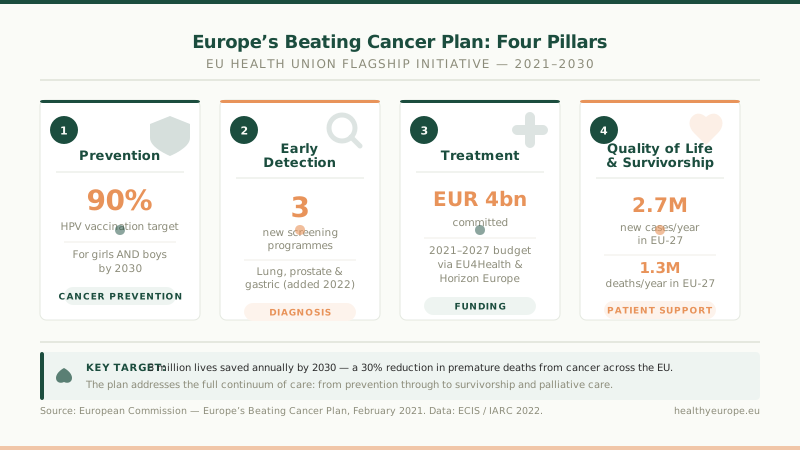
Cancer is the second leading cause of death in the European Union. Each year, approximately 2.7 million people receive a cancer diagnosis across the EU-27 — excluding non-melanoma skin cancer — and around 1.3 million die from the disease. Those numbers have remained broadly stable over the past decade, a function of competing pressures: an ageing population increasing overall incidence, offset by advances in early detection and treatment that have improved survival rates for several major cancer types. The question Europe’s Beating Cancer Plan, launched in February 2021, attempts to answer is whether coordinated EU-level action can shift that balance at scale — and whether four years into a seven-year programme, the evidence supports that possibility.
The plan was adopted by the European Commission on 3 February 2021 as part of the European Health Union framework, committing EUR 4 billion across the 2021–2027 EU budget period to a framework covering four pillars: prevention, early detection, diagnosis and treatment, and improving quality of life for cancer patients and survivors. The funding drew on multiple instruments — the EU4Health programme, Horizon Europe for research, and the Digital Europe programme — rather than a single dedicated budget line, which both reflected the plan’s cross-cutting nature and complicated accountability for specific outputs.
Prevention: The Structural Challenge
The prevention pillar of Europe’s Beating Cancer Plan is structured around the European Code Against Cancer — a public health communication tool identifying risk factors within individual control — and a set of regulatory and legislative measures targeting cancer-causing exposures at population level. The distinction matters because the two approaches operate through entirely different mechanisms and face different political obstacles.
On the regulatory side, the plan committed to strengthening tobacco control through a revised Tobacco Products Directive and a Tobacco Taxation Directive, and to reducing exposure to alcohol — the second largest preventable risk factor for cancer after tobacco — through a strengthened EU Alcohol Strategy. Both measures ran into significant industry lobbying and, in the case of the Alcohol Strategy, faced what the European Public Health Alliance characterised in its 2024 implementation review as outright delay, with commitments quietly downgraded or removed from the Commission’s legislative work programme.
Vaccine-preventable cancers represent a more tractable element of the prevention agenda. The plan set a target of vaccinating at least 90 percent of the eligible girl population against human papillomavirus — the virus responsible for virtually all cervical cancers and a significant proportion of oropharyngeal, anal, and vulvar cancers — and called for substantially increasing HPV vaccination rates among boys. The 90 percent target aligns with the WHO’s cervical cancer elimination strategy, adopted in 2020, which set the same coverage goal for girls by 2030.
Progress on HPV vaccination has been uneven but is accelerating. As of 2025, 47 of the 53 WHO European Region countries offer HPV vaccination programmes for girls, and 39 countries have extended programmes to boys. Coverage rates vary widely: Portugal has achieved over 90 percent coverage and serves as the benchmark, while rates in parts of Central and Eastern Europe remain substantially lower, reflecting differences in immunisation programme infrastructure, public trust, and health communication capacity. The Commission’s 2023 Council Recommendation on vaccine-preventable cancers provided a policy framework, but implementation is a member state competence, and the gap between political commitment and vaccination clinic coverage remains wide in several countries.
The plan’s approach to environmental carcinogens targeted by the Zero Pollution plan sits at the intersection of the prevention and environment agendas. Occupational exposure to carcinogens — asbestos, benzene, crystalline silica, diesel engine exhaust — remains a significant contributor to occupational cancer incidence in the EU. The revised Carcinogens, Mutagens and Reprotoxic Substances Directive, which has been progressively updated since 2017, continued to add substances and tighten occupational exposure limits under the Beating Cancer Plan’s implementation roadmap, though enforcement capacity at national level varies considerably.
Early Detection: Expanding the Screening Landscape
The most operationally significant deliverable of Europe’s Beating Cancer Plan on early detection has been the December 2022 Council Recommendation on Cancer Screening. The recommendation updated and substantially expanded the 2003 recommendation, which had been limited to three cancer types: breast, cervical, and colorectal cancer. The 2022 recommendation retained those three and established a new target — that 90 percent of the EU population eligible for these established programmes should be offered screening by 2025 — while extending the scope to three additional cancer types in varying degrees of recommendation.
For lung cancer, the recommendation called on member states to explore the feasibility and effectiveness of low-dose computed tomography screening, with attention to targeting high-risk profiles — primarily heavy smokers aged 50–75. Lung cancer is the leading cause of cancer death in the EU, accounting for approximately 20 percent of all cancer deaths, yet it has no established organised screening programme in most member states. The recommendation stopped short of mandating lung cancer screening, reflecting the evidence base at the time and the resource implications of population-wide CT scanning programmes.
For prostate cancer, the recommendation called for evaluation of the feasibility and effectiveness of organised screening programmes — similarly cautious language that acknowledged the ongoing scientific debate about PSA-based screening and its balance of benefits and harms. Prostate cancer is the most common cancer type among men in the EU, accounting for 12.5 percent of all diagnoses. The absence of a clear screening recommendation reflects genuine clinical uncertainty rather than political inaction, but it leaves national health systems navigating the question without EU-level guidance on implementation.
Gastric cancer screening was included for member states with high incidence and mortality rates — primarily the Baltic states, where Helicobacter pylori infection rates and associated gastric cancer burden are significantly above the EU average. The recommendation acknowledged the lack of universally applicable evidence while recognising that targeted national programmes in high-burden countries were warranted.
Treatment Access and the Innovation Gap
The diagnosis and treatment pillar of the Beating Cancer Plan is oriented around two ambitions: ensuring that all EU citizens have access to high-quality, guideline-based cancer care regardless of where they live, and accelerating access to innovative treatments — including targeted therapies, immunotherapy, and next-generation sequencing-informed diagnostics — across the EU.
Both ambitions run into the same structural constraint: health system organisation and financing are member state competences, and the differences between member states in oncology infrastructure, workforce, reimbursement timelines, and treatment protocols are substantial. A 2024 OECD analysis, Beating Cancer Inequalities in the EU, estimated that workforce productivity losses attributable to cancer cost the EU-27 approximately EUR 50 billion annually, and that cancer would cost the EU economy EUR 97 billion annually between 2024 and 2050 — figures that contextualise the EUR 4 billion committed to the plan itself.
The Cancer Imaging Initiative, launched under the plan, aims to build a federated infrastructure of medical imaging data to train AI-based diagnostic tools. The European Cancer Imaging Initiative connects oncology centres across member states to share imaging datasets in a privacy-preserving framework, with the goal of improving diagnostic accuracy for cancers where imaging is central to staging and treatment planning. The initiative is technically ambitious and faced early challenges in data governance harmonisation across national legal frameworks — an echo of broader challenges in the EU’s broader prevention strategy when it comes to data-sharing across health systems.
Time to treatment — the interval between diagnosis and initiation of first treatment — varies significantly across member states and cancer types. For certain time-sensitive cancers, including acute leukaemia and aggressive lymphomas, the variation can affect survival outcomes. The Beating Cancer Plan’s implementation roadmap called for the development of EU-wide quality indicators for cancer care, but progress on agreeing common methodologies and data collection frameworks has been slower than anticipated.
Quality of Life: The Under-Resourced Pillar
The fourth pillar — improving quality of life for patients and survivors — addresses aspects of cancer care that are frequently under-resourced relative to their clinical significance: psychosocial support, rehabilitation, management of treatment side effects, and the growing challenge of what oncologists call cancer survivorship. As treatment improves and five-year survival rates rise across many cancer types, the EU’s health systems are facing a growing population of people living with the long-term effects of cancer treatment — cardiovascular damage from certain chemotherapy agents, neuropathy, cognitive changes, and endocrine disruption from hormonal therapies.
The plan’s quality of life agenda includes commitments to develop survivorship care plans — structured documents setting out monitoring protocols and support services for cancer survivors — and to address disparities in access to palliative and supportive care. Both are areas where citizen empowerment in health decisions is particularly relevant: patients navigating post-treatment care often encounter fragmented systems and unclear pathways, and the evidence base for effective survivorship interventions is less developed than for the acute treatment phase.
Psycho-oncology — the specialist field addressing the psychological dimensions of cancer diagnosis and treatment — is unevenly resourced across EU member states. In some health systems, psychosocial support is integrated into oncology care pathways; in others, it is available only to patients who seek it independently and can access it privately. The plan’s commitment to address this dimension is clear; the mechanisms for driving convergence across 27 health systems are less so.
Implementation Gaps and the 2030 Horizon
A 2025 European Parliament Research Service study assessing the plan’s implementation across all EU member states between 2021 and 2024 identified several recurring gaps. Tobacco and alcohol control measures expected under the plan’s prevention agenda had been delayed or deprioritised. Defined outcome timelines were absent from many workstreams, complicating accountability. The 90 percent screening coverage target for breast, cervical, and colorectal cancer — ambitious for several member states — was not on track to be met by 2025 across all member states.
The structural challenge underlying many of these gaps is the same one that confronts EU health policy broadly: the Union can set frameworks, targets, and recommendations, but delivery depends on member state systems that differ sharply in funding, workforce, and administrative capacity. Cancer mortality rates vary by as much as 50 percent between EU member states for some cancer types — a gap that reflects differences in screening uptake, treatment quality, and risk factor prevalence rather than biology. The Beating Cancer Plan’s ambition to reduce those inequalities requires member states to act; EU-level levers to compel or accelerate that action are limited.
By 2040, cancer diagnoses in the EU are projected to increase by 19 percent and cancer deaths by 27 percent, driven primarily by demographic ageing. Against that trajectory, the plan’s implementation phase — 2024 to 2027 — is the critical window. The screening recommendation adopted in 2022 needs to translate into expanded national programmes; the HPV vaccination targets need to close the coverage gap between high- and low-performing member states; and the EU’s investment in cancer research through Horizon Europe needs to generate the clinical evidence that future policy cycles will require.
Whether the EUR 4 billion committed in 2021 is adequate to that task is a question the plan itself does not fully answer. The funding is distributed across multiple programmes and co-investments rather than constituting a single managed budget, making it difficult to track spending against specific outputs. The European Court of Auditors noted in its review of the plan that the absence of clear key performance indicators for several flagship initiatives complicated assessment of value for money and effectiveness — a finding that points to the distance between ambitious political commitments and the operational discipline required to deliver them.