The promise is consistent across the European Union: every citizen is entitled to healthcare, regardless of income. The delivery, however, is not. Life expectancy at birth within the EU-27 ranged across an eight-year span in 2023, according to data published in the OECD’s Health at a Glance report. Avoidable mortality — deaths that could have been prevented through timely and effective care — tells a similarly divided story. Two systems, broadly categorised as the Bismarck and Beveridge models, structure how member states raise and spend health funding, but neither architecture reliably predicts outcomes on its own. What drives the gap is more complex, and more stubborn, than the design of any single system.
Two Models, Twenty-Seven Variations
The intellectual lineage of European health systems traces back to two nineteenth-century political projects. The Bismarck model, introduced by the German chancellor Otto von Bismarck in 1883, built healthcare around compulsory social insurance contributions from employers and employees, administered by competing non-profit sickness funds. Coverage was tied to employment status — a feature that created persistent gaps for those outside the formal labour market, though subsequent reforms across all Bismarck-type systems have substantially closed those gaps. Germany, France, the Netherlands, Belgium, Austria, and most Central and Eastern European member states operate variants of this model.
The Beveridge model — named after the British economist William Beveridge, whose 1942 report laid the foundations for the UK’s National Health Service — organises healthcare as a universal entitlement funded through general taxation, with the state acting as both funder and primary provider. Sweden, Spain, Italy, Denmark, Finland, Portugal, and Latvia belong to this tradition. The distinction matters less in practice than it did in theory: decades of reform, co-payment structures, supplementary insurance markets, and managed care experiments have blurred the boundary between the two archetypes. But the underlying financing logic continues to shape how systems respond to economic shocks, demographic change, and political pressure.
One persistent finding from comparative analysis is that no model systematically outperforms the other on health outcomes. A 2021 study in the European Research Studies Journal examining efficiency across EU member states found that performance was more strongly associated with country-specific economic factors than with system architecture. The Euro Health Consumer Index, which produced its most recent structured ranking in 2018 before discontinuing publication, observed for several years running that Bismarck-type systems tended to score higher on accessibility and patient orientation — but that Beveridge systems could match or exceed them on population health indicators at lower per-capita cost.
The variation that matters most, in other words, is not between models but within them. And it is in that within-model variation that some of the EU’s deepest health inequalities reside. Arguments about system design connect directly to the economy of wellbeing framework, which challenges the premise that health spending is a cost to be managed rather than an investment that drives economic and social returns.
Six Countries: A Selective Comparison
Comparing health systems across EU member states requires care about what is being measured. Expenditure levels, outcomes, and access operate through different mechanisms and respond to different policy levers. The following six cases — Germany, France, Sweden, the Netherlands, Poland, and Spain — illustrate the range of approaches and results across the EU-27.
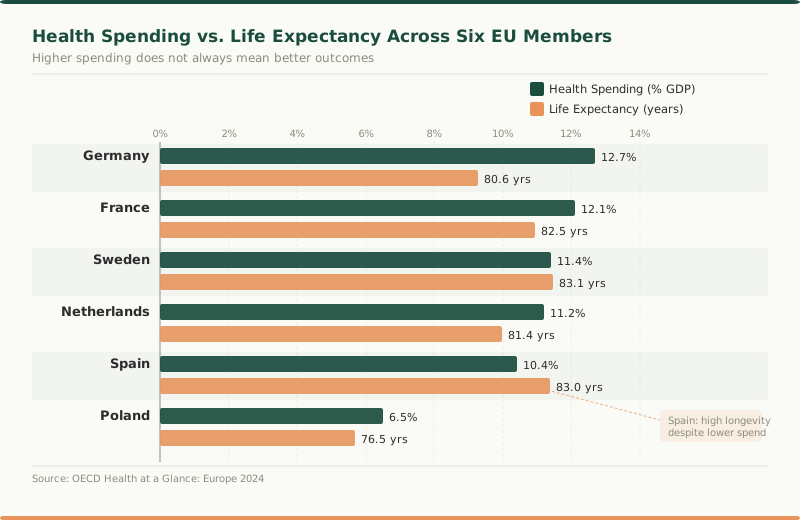
Germany spends the most on health as a share of its economy: 11.7 percent of GDP according to the latest OECD 2025 data, the highest figure in the EU. That investment buys a system with dense hospital infrastructure, extensive specialist access, and comparatively short waiting times. Life expectancy in 2023 stood at 80.8 years — slightly above the OECD average but notably below Spain, France, or Sweden. The paradox of high German spending and middling life expectancy outcomes reflects a structural emphasis on curative care over prevention, a fragmented primary care landscape, and persistently high rates of cardiovascular disease. The system is also structurally expensive to run: approximately 110 statutory sickness funds competed for members in 2024, generating significant administrative overhead without delivering proportionate efficiency gains.
France operates a hybrid system — social insurance at its core, supplemented by near-universal complementary coverage through mutuelles — that produces life expectancy above 83 years and one of the EU’s lower avoidable mortality rates. The system scores consistently well on acute care quality and specialist density. Its chronic vulnerability is financial: France has run persistent deficits in its national health insurance accounts for decades, and cost-containment reforms have repeatedly generated political confrontation, particularly over hospital funding and pharmaceutical pricing.
Sweden represents the Beveridge model at its most integrated: a county-council-administered system, largely tax-funded, with a strong primary care emphasis and a long record of high population health outcomes. Life expectancy exceeded 83 years in 2023. But Sweden’s system has faced growing criticism over waiting times — a structural tension in any predominantly public system — and a 2025 government commission examining primary care access found that GP availability had deteriorated in rural and low-income urban areas over the preceding decade.
The Netherlands operates a regulated private insurance model within a Bismarck framework: mandatory individual health insurance from competing private insurers, with government-set minimum coverage packages and risk-equalisation mechanisms to prevent adverse selection. The system consistently produced life expectancy around 82 years before the pandemic; recovery to that level was documented in 2023. Waiting times for specialist care and mental health services emerged as significant political issues during the 2020s, reflecting capacity constraints that the market mechanism alone has not resolved.
Poland illustrates the stakes of under-investment most starkly. Health expenditure as a share of GDP stood at approximately 8.1 percent in recent OECD data — below both the OECD average of 9.3 percent and the EU average of 10.0 percent. Life expectancy at birth runs approximately three years below the EU average. Preventable mortality was recorded at 202 deaths per 100,000 population, against an OECD average of 145; treatable mortality at 114 per 100,000 against an OECD average of 77. Poland’s State of Health in the EU Country Profile for 2023 identified avoidable hospital admissions at 809 per 100,000 population — nearly double the OECD average of 473 — pointing to systemic weaknesses in primary and preventive care. Prevention spending accounted for 1.7 percent of total health expenditure, less than half the OECD average of 3.4 percent.
Spain achieves the highest life expectancy in the EU at 84.0 years in 2023, despite health expenditure as a share of GDP that remains below Germany and France. The Spanish National Health System — a decentralised Beveridge model administered through 17 autonomous communities — delivers strong population health outcomes through an emphasis on primary care and a Mediterranean diet context that operates partially outside the health system itself. Regional variation within Spain is nonetheless substantial: health outcomes and service quality diverge between wealthier coastal communities and parts of the interior and south, a reminder that national averages can obscure significant subnational inequality.
Spending, Outcomes, and the Efficiency Question
Across the EU-27, healthcare absorbed an average of 10.0 percent of GDP according to OECD 2025 data. Germany’s 11.7 percent stood at one end of the spectrum; Poland and several other Central and Eastern European member states clustered well below the EU mean. The relationship between expenditure and outcomes is positive — higher-spending systems tend to produce better outcomes — but not linear. Spain’s performance relative to its spending level, and Poland’s comparatively poor outcomes despite a decade of system investment, both point to the importance of how money is spent, not just how much.
The metric of avoidable mortality — which the OECD decomposes into preventable mortality (deaths that could have been avoided through effective public health and primary prevention) and treatable mortality (deaths that could have been avoided through timely and effective healthcare) — provides a useful cross-national performance lens. Almost one third of all deaths across the EU could have been avoided through more effective prevention or care, according to OECD data. Member states with robust primary care systems and high vaccination coverage tend to score better on both dimensions. The Eastern European cluster — Poland, Romania, Bulgaria, Hungary — consistently shows elevated avoidable mortality rates, reflecting a structural legacy of under-investment, low prevention spending, and fragmented primary care networks that predates EU membership and has not yet been fully reversed.
The Euro Health Consumer Index, for the years it was published (through 2018), consistently placed the Netherlands, Switzerland, and the Nordic countries at the top of its 48-indicator ranking. The Netherlands scored 883 points in the most recent available data, behind Switzerland (893) and closely followed by Norway and Denmark. The index’s methodology, which weighted patient orientation and access heavily, gave structural advantages to Bismarck systems with competitive insurance markets — a finding that says something about system design but should be read alongside outcome-based indicators that present a more mixed picture.
The Workforce Crisis: A Structural Threat
Comparative analysis of European health systems in 2025 cannot be conducted without confronting workforce shortage as the most acute near-term structural risk. In 2022, twenty EU countries reported shortages of doctors; fifteen reported shortages of nurses. The OECD estimated the total shortfall at approximately 1.2 million doctors, nurses, and midwives across EU countries that year. More recent projections put Europe’s shortfall in health and social care workers at approximately 1.6 million in 2024, rising to a projected 4 million by 2030 — encompassing an estimated 600,000 doctors, 2.3 million nurses, and 1.1 million social care staff.
The demographic arithmetic driving those projections is straightforward. More than one third of doctors and a quarter of nurses in the EU are aged over 55 and expected to retire within the coming decade. New entrants are not replacing them at sufficient scale: interest in nursing careers fell in more than half of EU countries between 2018 and 2022, according to the OECD. The dual pressure of an ageing population — which increases demand for health services — and an ageing health workforce creates a structural mismatch that pay increases and recruitment campaigns alone are unlikely to resolve.
The crisis manifests differently across system types. In Bismarck systems with competitive insurance markets, urban specialist practices typically attract staff, while rural areas and primary care face the most severe shortages. In Beveridge-type national health services, salary compression and working conditions have driven attrition and early retirement, with the effects concentrated in nursing and allied health professions. In both models, internal EU labour mobility — which allows healthcare professionals to work across member states with recognised qualifications — has produced a pattern where better-paying Western European systems draw workers from lower-wage Central and Eastern European systems, exacerbating existing inequalities.
The OECD’s Health at a Glance 2025 report documented these workforce shortages in detail. In January 2025, the European Commission launched an initiative to support member states in retaining and attracting nurses through mentoring programmes and structural analysis of workforce pipelines — a first step in what the European Parliament’s research service has described as a crisis requiring coordinated EU-level action beyond the current toolkit of soft governance.
Post-COVID Resilience: What the Pandemic Revealed
The COVID-19 pandemic stress-tested European health systems against a common external shock, generating comparative evidence that might otherwise have taken decades to accumulate. The results were sobering across all system types but disproportionately damaging for systems that entered the crisis with existing structural weaknesses.
Life expectancy fell sharply across Europe in 2020 and 2021. By 2023, the EU average had recovered to 81.5 years — 0.2 years above pre-pandemic levels. But recovery was uneven: Germany and the Netherlands had not fully recovered to their 2019 life expectancy figures by 2023, a finding that partly reflects the toll of long COVID and postponed care across systems that prioritised acute COVID capacity. Eastern European member states, which experienced some of the highest excess mortality rates in the EU during the pandemic, faced additional recovery challenges due to limited intensive care capacity and lower baseline vaccination infrastructure.
The pandemic also exposed the cost of chronic under-investment in public health and prevention capacity. Systems that had built strong primary care networks and invested in digital health infrastructure — Sweden, Denmark, the Netherlands — demonstrated greater operational flexibility. Systems reliant on hospital-centric models struggled to redirect capacity without disrupting essential care. Elective procedure backlogs accumulated across virtually all member states; the European Observatory on Health Systems and Policies estimated in subsequent reporting that clearing those backlogs would require multi-year investment in surgical capacity and workforce.
The cross-border healthcare challenges that Directive 2011/24/EU was designed to address became acutely visible during the pandemic, when border closures suspended the informal and formal patient mobility arrangements that border-region populations had come to rely upon. That disruption has since accelerated discussions about formalising cross-border care cooperation — particularly in frontier regions where patients routinely access care across national lines.
The digital infrastructure underpinning health system reform received renewed political attention in the pandemic’s aftermath. Real-time health data sharing between member states proved largely impossible during the crisis; the European Health Data Space regulation, adopted in January 2025 and entering into force in March 2025, is the most significant structural response — though its operational implications will unfold over years rather than months.
The Convergence Question
European health policy operates under a structural constraint: the Union has no direct competence over how member states organise or fund their health systems. The EU can set frameworks, coordinate research, fund cross-border initiatives, and — through the European Semester process — issue country-specific recommendations on health spending and reform priorities. But health system design remains national, and the variation across member states reflects choices that democratic politics in each country has produced over decades.
Whether those systems converge over time is an open empirical question. The evidence to date is mixed. On structural indicators — hospital bed density, physician-to-population ratios, vaccination coverage — some convergence between Western and Eastern European member states is visible over the 2004–2024 period. On outcome indicators — life expectancy, avoidable mortality, preventable hospitalisation — the gap between the EU’s top and bottom performers has narrowed more slowly, if at all. The structural factors that produce those gaps — income levels, education, housing conditions, environmental exposures — are not primarily health system variables, even if health systems are where their consequences arrive.
The framework that offers perhaps the most productive lens for understanding system performance is precisely the one that is hardest to operationalise: the relationship between health investment and economic output that defines the economy of wellbeing approach. Systems that treat healthcare as a productive investment rather than a cost to be minimised tend, over time, to produce both better health outcomes and stronger fiscal foundations. Whether that argument is gaining sufficient political traction — in the member states where it is most needed — is the more important question.