The most comprehensive chemical restriction in EU history faces industry pushback — but the health evidence keeps mounting
Per- and polyfluoroalkyl substances are not a single chemical. They are a class of roughly 10,000 synthetic compounds linked by a common structural feature: chains of carbon-fluorine bonds among the strongest in organic chemistry. That bond strength is what makes PFAS useful — non-stick, heat-resistant, waterproof, persistent under conditions that degrade almost every other organic material. It is also what makes them a regulatory problem of unusual complexity. Once released into the environment, PFAS do not break down through natural weathering or biological processes on any timescale relevant to human health policy. They accumulate in soil, water, and living tissue. They cross the placenta. In population monitoring studies, PFAS are detectable in the blood of virtually every person tested in industrialised countries.
The regulatory response within the European Union has been building for years, but 2023 marked a qualitative shift: the submission to the European Chemicals Agency of a universal restriction proposal covering all PFAS simultaneously — the broadest regulatory action of its kind attempted anywhere in the world. Three years on, the proposal is still moving through ECHA’s scientific evaluation process. The timeline has extended, the number of proposed exemptions has grown substantially, and industry engagement has been intense. What has not materially changed is the body of evidence on which the restriction case rests.
What PFAS Are and How They Enter the Body
The term PFAS encompasses compounds ranging from the well-studied perfluorooctanoic acid (PFOA) and perfluorooctane sulfonate (PFOS) — both already restricted under earlier EU and international agreements — to thousands of less-studied fluorinated compounds introduced by manufacturers as substitutes once the original compounds faced regulation. This phenomenon, sometimes described as regrettable substitution, has been a persistent challenge in chemical regulation: restricting individual substances while leaving the broader class unaddressed creates incentives to reformulate around the restriction without reducing overall exposure.
PFAS enter the human body through multiple routes. Dietary exposure via food packaging, cookware coatings, and contaminated fish from polluted water bodies is well-documented. Drinking water contamination from industrial discharges, the use of aqueous film-forming foam (AFFF) at airports and military sites, and the land application of PFAS-containing sewage sludge have created localised hotspots where population exposures are substantially above national averages. Occupational exposure in manufacturing, firefighting, and certain healthcare contexts adds further pathways.
The EU’s revised Drinking Water Directive, adopted in 2020 and with key provisions entering into force in January 2026, introduced binding parametric values for PFAS in drinking water for the first time across all member states. The directive sets a limit of 0.10 micrograms per litre for individual PFAS among a list of 20 specified compounds, and a total PFAS limit of 0.50 micrograms per litre. Water suppliers are now obliged to monitor for compliance and to act where values are exceeded — an obligation that, in several member states with known groundwater contamination, has required investment in advanced treatment infrastructure. This intersection of drinking water quality and the EU’s environmental health framework reflects how PFAS regulation cuts across multiple regulatory domains simultaneously.

The Health Evidence: Cancer, Immune Function, and Thyroid Disruption
The scientific case for restricting PFAS as a class rather than compound by compound rests on a growing body of evidence linking exposure to multiple adverse health outcomes. The European Food Safety Authority’s 2020 scientific opinion on PFAS in food established a tolerable weekly intake for the sum of four key PFAS based on effects on the immune system — specifically, reduced vaccine antibody response in children — characterising immune suppression as the critical effect for regulatory purposes.
Since that opinion, evidence on other health endpoints has continued to accumulate. Epidemiological studies have linked PFAS exposure to thyroid function disruption, with some research identifying dose-response relationships between serum PFAS concentrations and altered thyroid hormone levels. The thyroid implications are of particular concern during pregnancy, when maternal thyroid hormones play a critical role in foetal neurological development.
The cancer evidence is more differentiated. The International Agency for Research on Cancer classified PFOA as a Group 1 human carcinogen in 2023, citing sufficient evidence for associations with kidney cancer and testicular cancer. Several other PFAS have been classified as possible human carcinogens. Large-scale ecological research published in the Journal of Exposure Science and Environmental Epidemiology has examined county-level associations between PFAS in drinking water and incident cancer burden, identifying positive associations for multiple cancer types in high-exposure populations.
Reproductive and developmental effects add a further dimension. Certain PFAS are classified as toxic to reproduction under EU chemical regulations. Pre-natal exposure has been associated with reduced birth weight, altered immune development, and in some cohort studies with neurodevelopmental outcomes. The developmental window of concern — foetal life and early infancy — means that regulatory action, once delayed, cannot fully compensate through retrospective exposure reduction for the population already born during the period of elevated contamination.
The ECHA Restriction Proposal: Timeline and Current Status
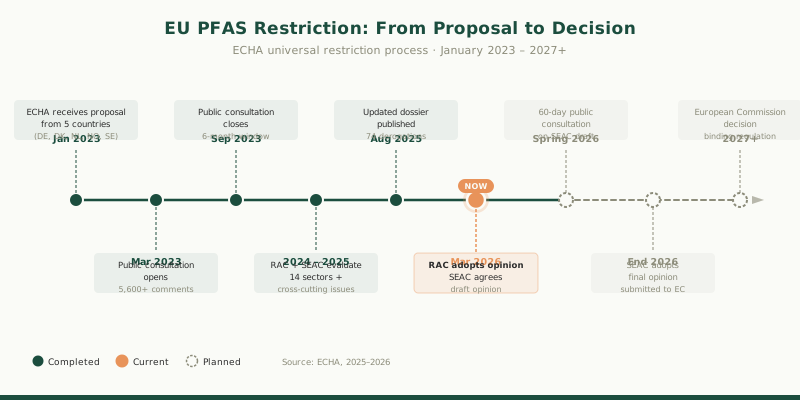
The universal PFAS restriction proposal was submitted to ECHA in January 2023 by the national chemical authorities of five countries: Denmark, Germany, the Netherlands, Norway, and Sweden. The proposal invoked REACH Annex XV, which allows member state authorities to propose restrictions on substances posing unacceptable risks. The scope — all PFAS, across all uses — was without precedent in REACH’s history.
ECHA opened a six-month public consultation in March 2023, during which it received over 5,600 scientific and technical comments. The volume and technical complexity of industry responses — from manufacturers of fluoropolymers, semiconductor equipment, medical devices, and defence applications — reflected the breadth of industrial sectors that would be affected by a comprehensive restriction.
In August 2025, the five dossier-submitting authorities published a substantially revised version of the proposal. The revision increased the number of proposed derogations from 26 to 74, adding specific time-limited exemptions for sectors including fluoropolymers used in semiconductor fabrication, certain medical device applications, and renewable energy infrastructure components. Fluoropolymers — which differ structurally from the most acutely toxic PFAS and are argued by industry to present lower migration and environmental release risks — received particular attention, with the updated proposal introducing a third regulatory option permitting continued use under conditions designed to minimise emissions.
As of early 2026, ECHA’s Committee for Risk Assessment (RAC) is expected to adopt its final opinion in March 2026, with a public consultation on the draft opinion planned for spring 2026. The Committee for Socio-Economic Analysis (SEAC) will then open a 60-day public consultation in spring 2026, with SEAC’s final opinion anticipated by the end of 2026. ECHA aims to transmit both committee opinions to the European Commission by late 2026 or early 2027. The Commission will then prepare a restriction regulation for vote in the REACH Committee of EU member state representatives — a step that, given the political economy of the proposal, is expected to involve significant further negotiation.
The process as a whole — from submission to Commission decision — is on track to exceed five years, a timeline that health advocates have criticised as inadequate given the ongoing exposures during the evaluation period. Industry associations have contended, conversely, that the assessment timeline reflects necessary scientific rigour and that the proposal’s scope requires careful evaluation to avoid disrupting supply chains for critical applications without technically feasible alternatives. This debate connects to the zero pollution ambition at the centre of the EU’s environmental health agenda, where the tension between regulatory ambition and implementation timelines is a recurring structural feature.
Industry Pushback: What Is Actually Being Contested
The scale of industry engagement with the ECHA restriction process has been substantial by any metric. Over 5,600 responses during the 2023 consultation, detailed sector-by-sector technical dossiers from trade associations, and commissioned socio-economic assessments arguing that specific derogations are necessary to preserve manufacturing capacity in sectors deemed strategically important — semiconductors, defence, medical devices, renewable energy — characterise an industry response calibrated to contest the restriction’s scope rather than its underlying principle.
The arguments advanced cluster around several themes. First, technical feasibility: that no alternatives to certain fluorinated compounds exist at commercially viable scale for specific applications, and that restricting them would either halt production of critical goods or shift manufacturing outside the EU without reducing global PFAS use. Second, differentiation: that fluoropolymers used in high-performance industrial applications release negligible quantities into the environment compared with PFAS used in consumer products or as processing aids, and that treating them identically misrepresents the risk profile. Third, proportionality: that the broadest version of the restriction would impose costs — measured in disrupted supply chains, transition investment, and potential shortfalls in clean energy manufacturing — that exceed the health benefits achievable through a more targeted approach.
The scientific committees’ task is to evaluate these arguments on their merits, not their provenance. The expansion of derogations in the August 2025 dossier update suggests that some industry arguments have been accepted as technically grounded by the dossier submitters. What the final SEAC opinion will recommend regarding derogation scope — and how the Commission will weigh that recommendation against the zero pollution commitment — will determine whether the restriction, when it eventually reaches a vote, represents a genuine paradigm shift in EU chemical governance or a more incremental adjustment to existing compound-by-compound regulation.